
Bishopscourt Beauty
The Brief
Besides, the pre-requisite of a fairly large lawn area for children and dogs, we were largely given free rein to design ‘a garden which would create interest and reflect the grandeur of the house’. It must be added that the client was closely consulted throughout and contributed considerably to the design process.
 Due to its’ age, the garden already contained a quantity of well established trees and shrubbery. A great advantage in many ways, with the exception of having blocked out some magnificent views onto the back of Table Mountain and beyond.
-
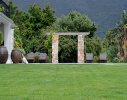 Additional soil was trucked onto site to create a level lawn area, off-setting the residence
 -
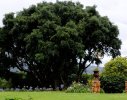
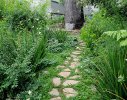 The stone pathway ends at a viewing seat at the base of a beautiful old Stone Pine tree
 -
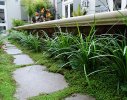 Feature planting to interior atrium and water feature
 -
 A circular pond and fountain supply movement and ambience to the forest walk
 -
 Zen garden with potted Japanese maple
 -
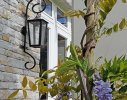 Climbing Wisteria softens and complements the architecture
 -
 Dry-packed stone retaining walls allow for vertical inter-planting
 -
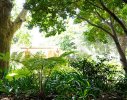 Tree ferns were planted extensively throughout the garden in order to tie the various elements together
 -
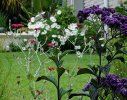 Flowerbeds soften the lawn edge
 -
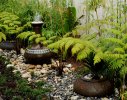 A restful and contemplative Zen atmosphere, enhanced by water movement, was designed for the sauna/spa exterior view
 -
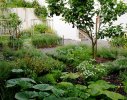 A potager of fruits, vegetables and herbs in the rear garden
 -
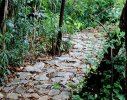 A stone pathway meanders through the bamboo grove
 -
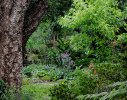 A view of the forest dell
 -
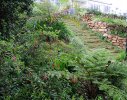 A stone stairwell draws the viewer down to the lower garden
 -
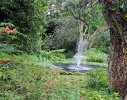 Lower garden pathway towards fountain
 -
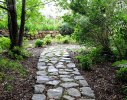 A granite stone pathway creates strong lines and movement through the forest
 -
 The pathway meanders through the traditional stone and rafter pergola
 -
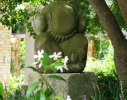 Statue in Zen garden
 -
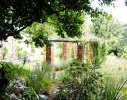 A view from the driveway entrance over the garden
 -
 Stone pillars supporting urns indicate the stairway to lower garden


Garden Features:
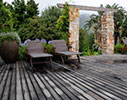
Over and above practical reasons, this deck was designed in order to bond the transition from the hard paved forecourt to softer lawn. The deck simultaneously separates and designates the swimming pool area.
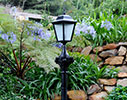
This Victorian cast iron street lamp was ‘rescued’ during the demolition process of the former residence and restored for re-use. The placement of the lamp produces a soft glow over the fountain at night, creating a romantic setting.

The pergola and assorted stone arches were constructed by our team. The wooden rafters were custom-designed to match those used in the residential architecture.

The fountain was designed to create interest and movement in order to draw the viewer down to investigate the lower garden. The water movement is nonetheless soft and sets the tone for the peaceful forest garden.
The Design Approach
Due to the large space of the acre-sized property, we set out to create several ‘rooms’ within the garden. Thereby enticing the viewer to explore and be led through the garden to areas of new discovery. The design and views from within different functional areas of the dwelling were a contributing factor.
 The original outdated dwelling was mostly demolished and re-designed, although the ‘foot print’ of the house remained similar. The initial home that stood on a gently sloping property allowed for only a narrow strip of lawn. Soil was trucked in to create a wider, level lawn, which was proportionate to the height and size of the house. Dressed rock lawn edging, bordered by a low clipped hedge, was intended, in order to produce a sense of austerity and to offset the elegance of the architecture. This also served to contrast with the wilder, free-flowing forest area surrounding, and below, the lawn.
Several magnificent established trees existed on site, as many of which, as possible, were retained and protected during construction. In order to lead the observer to the lower forest walk, and reading off the central axis of the house, a formal circular fountain pool was designed below a wide flaring set of steps constructed of dressed rock. We were fortunate that two large existing cork oaks lined up well, either side of the central axis. These two woodland guardians served to ‘hold’ the space ideally, while creating the sense of a forest dell. The ambience is further enhanced by the planting of violets, arum lilies, clivias, assorted ferns and other stream side, shade loving perennials. An old cast-iron Victorian garden lamp was rescued during the demolition stages, restored to its’ original state, and resurrected as a garden lighting feature.

From the fountain, the stone pathway forks left through to a bamboo grove. It then leads back to an open, sunnier space where a ‘hot’ garden of orange, yellow and red flowering shrubs sits below the swimming pool. Ultimately, the path returns back to a balau timber flight of stairs, contiguous to the upper level pool decking.
Adjacent to the pool deck and to the side of the house, a trio of Moroccan styled pots form a water feature in a Zen-like plant setting. From the interior, this serves as a contemplative and calming outlook from a large Sauna room. The patio leading off the office, situated at the opposite end of the house, was treated in a similar minimalist style.
Leading off the Zen garden and situated to the back of the house is a Potager, supplying organic herbs and vegetables to the kitchen close by.
 The alternative pathway diverging from the fountain pond, meanders through a shade garden of azalea, magnolia and tree ferns returning to a meadow garden on the lawn level. From here, the viewer is led through a traditional ‘stone and rafter’ pergola trailing purple wisteria and bordered by lavender. The pathway wanders further through an eclectic mix of indigenous and exotic shrubbery, ultimately finishing at a viewing bench and stone table at the foot of a magnificently stout old stone pine.
Two stone arches at opposite ends of the length of the lawn, add symmetry and announce secondary pathways.
Dry packed stone walls were used to retain the level change between lawn and lower forest area, maintaining an organic and natural feel to the untamed lower forest walk. A pale granitic rock was used to retain the driveway border gardens in order to ‘lift’ the darker shade area and to blend with the paving.
Tree ferns were planted throughout the garden in order to create a common thread, knitting the different zones together.
‘Every individual should have access to a garden, in order to be closer to God’’ – Carl Jung