
Indigineous Gem
The Brief
This beautiful large property, situated in Baviaanskloof, Hout Bay, has a two acre size back garden stretching up the mountain slope. In addition, there is a natural mountain stream running through one side of the grounds.
The house had been extensively renovated by the new owner in a contemporary minimalist style. The garden in the immediate vicinity of the house needed to reflect the architecture.
The larger brief was to rehabilitate the indigenous vegetation on the land behind the dwelling, reaching up the mountain slope.
The slope, was at this stage overrun with invasive alien plants, with difficult pedestrian access, but potentially allowed for magnificent views over the Bay. An existing perennial mountain stream was under-utilised as a natural feature.
The property includes two guest houses and the owners entertain a number of foreign guests for whom, in many instances, it is often a first introduction to the unique indigenous Fynbos of the Western Cape.
-
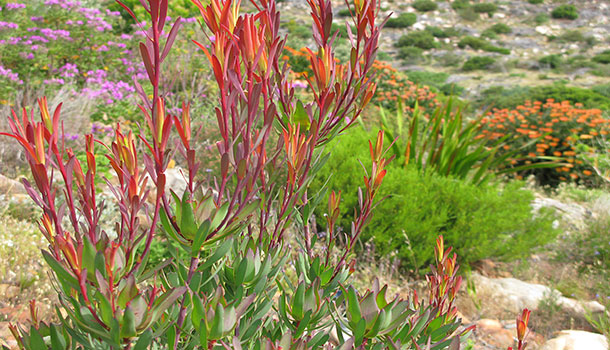
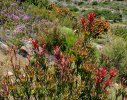 Several hybridised Fynbos species were planted for their bold foliage colours
 -
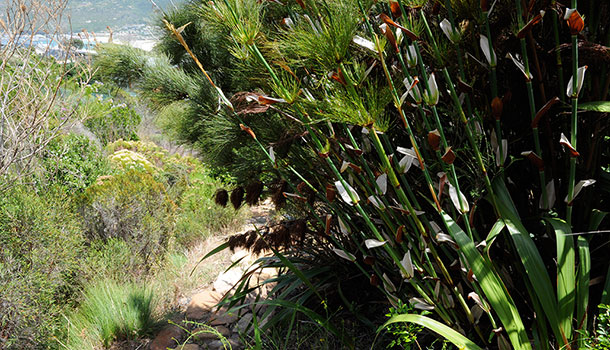
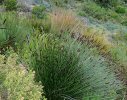 A grouping of restio's adds texture to the matrix
 -
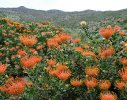 Pincushions in full bloom
 -
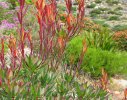 Foliage colour and texture insure year - round interest
 -
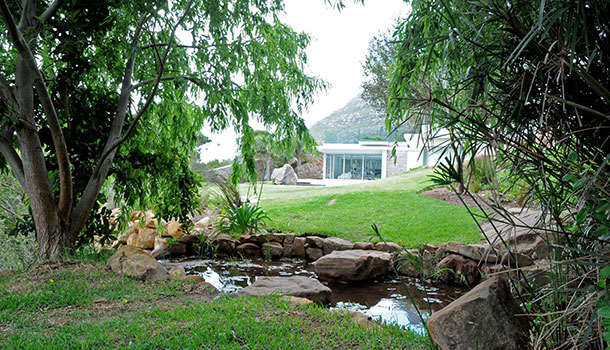
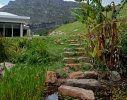 A playful stream crossing
 -
 Pathways of local sandstone give access to the mountain slope
 -
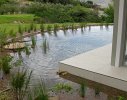 The natural swimming pool shortly after construction and prior to plant establishment
 -
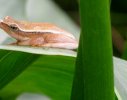 An endemic local resident - the Arum Lily frog
 -
 The stone pathway leads up to the viewing platform
 -
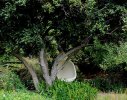 Contemporary swing seat alongside lower stream and pool
 -
 View of upper stream and re-generated vegetation
 -
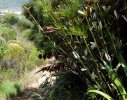 Restios adjacent to pathway
 -
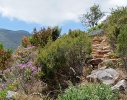 Pathway through endemic vegetation
 -
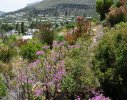 A large degree of local vegetation re-establshed itself with the removal of alien invasives
 -
 Viewing platform near top of slope
 -
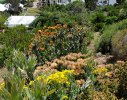 A mixture of re-generated and planted Fynbos elements
 -
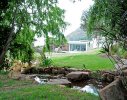 Trees planted along the stream course frame a boulder crossing
 -
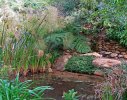 A pond with walkway and stairs on lower stream
 -
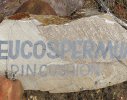 Large groupings of the 'Fynbos big 5' were named accordingly








Garden Features:

This picture was taken shortly after the mountainside was cleared of alien vegetation. Although a substantial number of endemic shrubs and groundcovers were planted, consistent maintenance and weeding out of alien invasive seedlings led to the emergence of numerous bulbs and germination of formerly suppressed Fynbos elements.
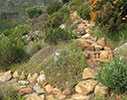
Use was made of the abundant natural rock present on site to build pathways and stairs. These were conceptualised to copy the mountain trails found on Table Mountain and the Peninsula.
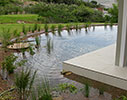
Shortly after construction and prior to water plant establishment. This pool is situated outside the master bedroom, and forms the interface between the established and mountain Fynbos gardens.
The Design Approach
 Several existing large palm trees, scattered throughout the garden, were lifted and transplanted into groupings, particularly near the swimming pools. This set the precedent for groupings of smaller structural shrubs, to be repeated around the dwelling. Mass groupings of single species of form plants were used to high-light the minimalist style of architecture. These included indigenous species such as strelitzea juncea and restio species. In this manner the transition from exotic palms around the primary swimming pool, to strict endemic Fynbos on the mountain slopes was progressively introduced. A natural swimming pool was installed by a sub-contractor on the side of the house, linked to the deck of the main bedroom. The natural swimming pool is situated halfway between the more formalised minimalist planting and informal wild mountain slope planting- thereby assisting in the transition.
All alien invasive vegetation was cut off at ground level (to prevent re-sprouting) and removed from site. Although pathways had been pre-designed, it became apparent that several pathways naturally evolved during this process, as labourers intuitively created routes which required minimal physical effort. Pathway design was re-adapted accordingly. Use was made of the abundant natural rock present on site to build and delineate pathways with rock paving and stairways. The primary pathway was constructed to reach the viewing point near the top of the slope. A linking meander was created in order to lead the viewer along the streamside.
Permission was sought, and granted, by the local authority, to create pools and waterfalls within the stream. Besides the obvious aesthetics of creating larger reflective water surfaces and movement, the pools also assisted in creating habitat diversity for a wider range of garden fauna and flora. Simultaneously, the erosive power of the stream, particularly during winter flooding, was considerably reduced downstream. Hired earth moving machinery was used to create the series of pools within the stream bed. This was co-ordinated to take place in mid-summer, when stream flow was at its’ lowest. Stepping stone pathways and bridges were constructed across the resulting ponds, which encouraged observer interaction with the aquatic life and waterplants. Indigenous tilapia fish were introduced.
 A survey was undertaken of local Fynbos species existing on the surrounding and adjacent mountains. These were sourced from growers and planted between and around pathways. Indigenous riparian vegetation was introduced along the watercourse. A number of indigenous trees had already established themselves on the eastern boundary of the property. To add interest and variety, as well as introduce some much needed shade on the hot north facing slope, additional trees were added and inter-planted to create a small indigenous forest zone and meander.
Groupings of the Fynbos ‘Big Five’, (Proteas, Pincushions, Leucadendrons, Restios and Ericas) were planted intermittently en masse adjacent to the pathways and labelled with signboards for the curious – a la Kirstenbosch!
"Don't be a moegoe, smell the boegoe" – Coy Sonn Y